
· News
ConnectEd: what two years of piloting actually taught us about youth work
Four organisations from Slovenia, Spain, Serbia and Belgium set out to tackle mental health, community building and learning to learn as a single issue. This is what they found.

For two years, four organisations from Slovenia, Spain, Serbia and Belgium have been trying to answer a far from straightforward question: what really helps young people cope with everyday life, learn and connect with one another, beyond a worksheet or a talk?
The response from ConnectEd: Bridging Minds, Building Communities — an Erasmus+ project led by TiPovej!, in partnership with BACKSLASH (Spain), Libero (Serbia) and Connect International (Belgium) — begins by treating three areas as a single issue rather than three separate topics: mental health, community building and learning to learn.
Pre-workshop assignment
Before writing a single session, the partners carried out the less glamorous work. They reviewed studies, NGO reports, EU and government documents, case studies and databases of best practice in the four countries, looking for approaches to learning to learn, mental health and community building that had already delivered tangible results.
A handbook designed to be used tomorrow
That research formed the basis of the ConnectEd Manual: a comprehensive set of ready-to-use workshops, featuring learning techniques such as the Feynman Technique and spaced repetition, the fundamentals of mental health — from myths and realities to emotional regulation — and community-building through rituals, shared purpose and conflict resolution. No theory for theory’s sake: each session is designed to be delivered to a room full of teenagers with just a few photocopies and a stopwatch.
Two playlists, two audiences
The same content is also available in digital format, in two playlists on the Cities of Learning platform. One is designed for educators and youth workers — practical activities on stress management, problem-solving, empathy and teamwork, which are just as useful in a classroom as they are in a youth centre. The other, LifeSkills 360°, is aimed directly at young people, so that they can work through it at their own pace.
200+
young people took part in the pilot scheme
3
countries where the workshops were trialled
2
digital playlists, open to anyone
The trial involving real young people
The partners ran the workshops with more than 150 young people in Serbia, Slovenia and Spain, and assessed what had changed. The results, set out in a joint evaluation report by the three countries, are honest rather than triumphalist.
The results are honest, rather than triumphalist.
Stress management showed the most marked improvement across all groups, rising by almost a full point on a five-point scale in some cases. Understanding of community building also rose sharply, particularly in terms of participants’ confidence in contributing their own ideas, rather than merely discussing the concept. In terms of ‘learning to learn’, the young people gained, above all, an awareness of how they study and reflect. Motivation, regular reflection and conflict resolution proved more difficult to improve in a single session — a reasonable outcome, which the partners do not hide, and which highlights precisely what the upcoming workshops need to continue working on.
Ten recommendations for youth workers
Of the ten recommendations that emerged from the project, these set the tone:
- Ensure that sessions are participatory, not lecture-based.
- Incorporate rituals and a shared mission for the group.
- Check where the group is actually setting off from before you start.
- Link what happens in the room to something that follows on from it.
What comes next
It is on that last point that the story does not end with the project. The four partners have committed to remaining involved once the funding has come to an end, keeping in touch with the young people who took part to see whether the changes brought about in a workshop are still evident months or years later.
Slovenia is already demonstrating how this works in practice. TiPovej! operates directly within a secondary school, working alongside a careers adviser with a background in psychology who now runs the ConnectEd workshops for new groups independently and monitors the progress of those who have already taken part. At the same time, the project is expanding its reach through youth centres, linking the school with the youth work sector and opening up further opportunities to continue implementing and developing what has been successfully trialled.
The short-term figures are encouraging. What happens over the coming years, as these young people put what they have learnt into practice, is the story that is still being written. For now, the research, the handbook, the two playlists, the recommendations and the evaluation report are all available, freely accessible, to anyone working with young people — whether in a classroom, at a youth centre, or somewhere in between.
Project partners
- TiPovej!, Slovenia (coordinator)
- BACKSLASH, Spain
- Libero, Serbia
- Connect International, Brussels
ConnectEd is co-funded by the European Union through the Erasmus+ programme. The views expressed in this text are those of the authors and do not necessarily reflect those of the European Union.
Related projects

Erasmus+ · Completed
ConnectED
ConnectEd: Bridging Minds, Building Communities
ConnectED: Bridging Minds, Building Communities aims to strengthen the capacities of youth workers to support young people in taking control of their learning, promoting their mental and emotional…
2024–2026 · Mental and emotional wellbeing
View the project ConnectEd: Bridging Minds, Building Communities
More news
· News
From local practice to global policy action: our policy recommendations for digital youth work are out
A new policy paper from the Re(In)novating Digital Youth Work project makes the case for digital youth work as a distinct, rights-based and professional…
Project: Re(in)novating
· News
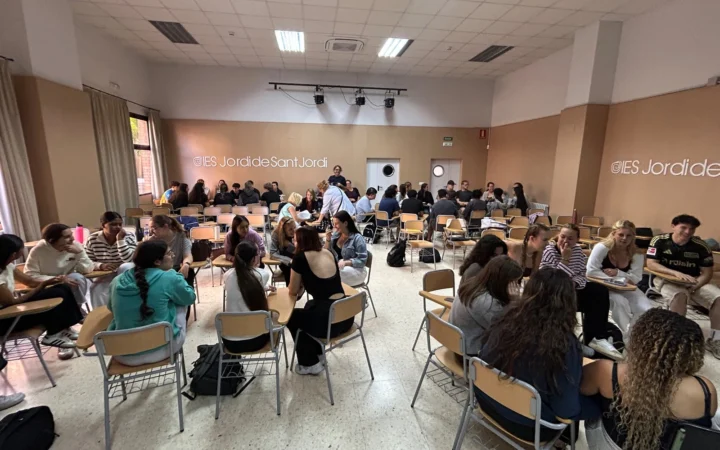
Europe Is Yours: 50 young people from Valencia and Germany discover Europe’s opportunities for youth
Exchanges, volunteering, travel and training: the BACKSLASH workshop at IES Jordi de Sant Jordi showed students from Valencia and a visiting group from Germany…
· News
BACKSLASH joins the European debate on AI and fairer access to EU funding
On 8 October, BACKSLASH Director Gilberto Martínez takes part in the BestAI Final Event in Brussels to ask whether AI can make EU funding…